
AI tools now screen the majority of resumes before a human recruiter ever sees them — which means vague, implied experience gets filtered out before anyone reads it. This guide breaks down exactly what to name explicitly on an AI/ML resume in 2026: the baseline AI vocabulary every adjacent role should include, the deeper technical terms ML Engineers and Data Scientists need, real weak-vs-strong bullet rewrites, and the formatting choices that determine whether a resume even parses correctly. It's built on real recruiter feedback and firsthand experience, not generic career advice — practical enough to apply to your own resume today.
If you're applying for an AI or ML role in 2026, your resume isn't being read first — it's being screened by an AI. That single fact changes almost everything about how you should write it. This guide is not a list of generic tips ("use action verbs," "keep it to one page"). It's a practical, specific breakdown of what to put on an AI/ML resume in 2026, based on real recruiter feedback and what's actually getting candidates past the first filter.
The Reality Check: AI Is Reading Your Resume Before a Human Does
Here's the assumption that's costing candidates interviews: "If I hint at my experience, a good recruiter will read between the lines."
That's no longer true, and for AI/ML roles specifically, it was never true to begin with — these are exactly the teams most likely to have automated their own hiring funnel. 57% of companies already use AI somewhere in their hiring process, and resume review is the single most common use case[1]. In practice, that means a screening tool matches your resume against the job description using keyword and semantic matching, and ranks or filters candidates before a recruiter sees anything.
The practical consequence: implication doesn't survive the filter. If you built a retrieval-augmented pipeline but wrote "improved chatbot accuracy," the screening model has nothing concrete to match against. If you fine-tuned a model but described it as "improved model performance," you look identical to someone who changed a learning rate once. Vague, softened language — the kind that used to read as modest and professional — now reads as empty to the system deciding whether a human ever sees your name.
The fix isn't to stuff your resume with buzzwords. It's to be explicit and specific about exactly what you built, with which tools, and what changed as a result. Say the tool name. Say the technique. Say the number.
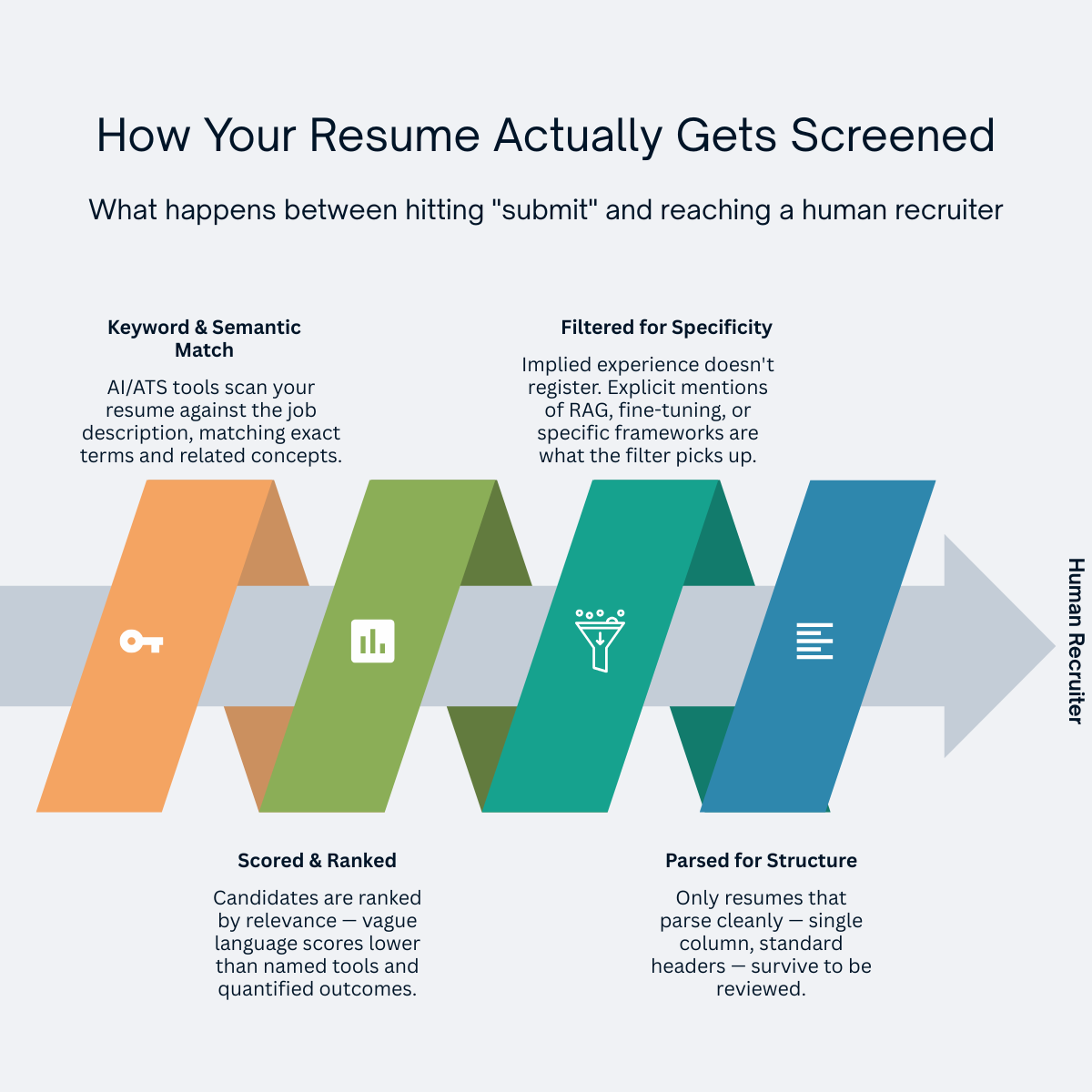
What actually happens between hitting "submit" and reaching a human recruiter.
The Recruiter Story That Changed How I Write Resumes
A recruiter once gave me feedback that reframed how I think about this. I'd applied with a resume that described my work in fairly general terms — assuming that anyone technical enough to be reviewing an AI role would recognize the substance behind it. The recruiter's response was blunt: my resume needed to explicitly name things like MCP (Model Context Protocol), Claude Code, which vector database I'd used, whether I'd built a RAG pipeline and with what tooling, and whether I had hands-on prompt engineering and LangChain experience — even in cases where the underlying work already demonstrated all of it.
The point wasn't that I lacked the experience. It was that unnamed experience doesn't exist to a screening system, and increasingly, doesn't exist to a time-pressed human reviewer either. Nobody is going to infer "familiar with vector search" from a sentence like "worked on search relevance." You have to name it.
That conversation also surfaced an important distinction, which is the core of the next section: some of these terms only make sense on an ML Engineer or Data Scientist resume — but some of them belong on almost any AI-adjacent resume in 2026, regardless of the role.
The AI/ML Vocabulary Checklist: What to Include (and Why)
Baseline literacy: include these regardless of your specific role
These aren't deep specializations — they're becoming table-stakes fluency, the same way "Git" or "REST APIs" became table-stakes for software engineers a decade ago. If you're applying to any role that touches AI-assisted products or workflows (backend, full-stack, product, even QA), include what applies:
- AI coding assistants — name the ones you actually use: Claude Code, GitHub Copilot, Cursor. Recruiters read this as a proxy for how fast and how independently you ship.
- Prompt engineering basics — even at a "I write reliable, structured prompts for production features" level. You don't need to claim research-level expertise to list it.
- LLM API integration — experience calling OpenAI, Anthropic (Claude), or similar APIs directly in an application, including handling streaming, function/tool calling, and structured outputs.
- RAG (Retrieval-Augmented Generation) — conceptual understanding — even if you didn't build the pipeline yourself, knowing what it is and where you've used a RAG-backed feature is worth a line.
- MCP (Model Context Protocol) — if you've built or integrated an MCP server or client, name it explicitly. It's new enough that naming it signals you're current.
Role-specific depth: for ML Engineer, Data Scientist, and Applied AI roles
This is where you need to go deep and specific — generic phrasing here is the fastest way to get filtered out of a technical role:
- Vector databases, by name — Pinecone, Weaviate, Qdrant, Milvus, pgvector. Don't write "vector database"; write which one, at what approximate scale, and why you chose it.
- RAG frameworks and orchestration — LangChain, LlamaIndex, Haystack, or a custom-built pipeline. State which, and what it was for (document Q&A, internal search, agentic tool use).
- Agent frameworks — LangGraph, CrewAI, AutoGen, or MCP-based agent tooling, if applicable.
- Embeddings and fine-tuning — which embedding models (OpenAI's, Cohere's, open-source sentence-transformers), and whether you've fine-tuned or just consumed pretrained models. Both are legitimate — say which.
- Evaluation tooling — RAGAS, promptfoo, or custom eval harnesses. Evaluation experience is underrepresented on resumes and disproportionately valued by hiring managers because it signals rigor, not just prototyping.
- MLOps / serving — MLflow, Weights & Biases, vLLM, Triton Inference Server, or your cloud provider's equivalent (SageMaker, Vertex AI, Azure ML).
The rule that ties both lists together: name the tool, name the technique, quantify the outcome. "Reduced RAG hallucination rate by 30% by adding a reranking step with Cohere's reranker" beats "improved AI feature accuracy" every time — to a human reader and to the screening model.
Weak vs. Strong: Real Before/After Examples
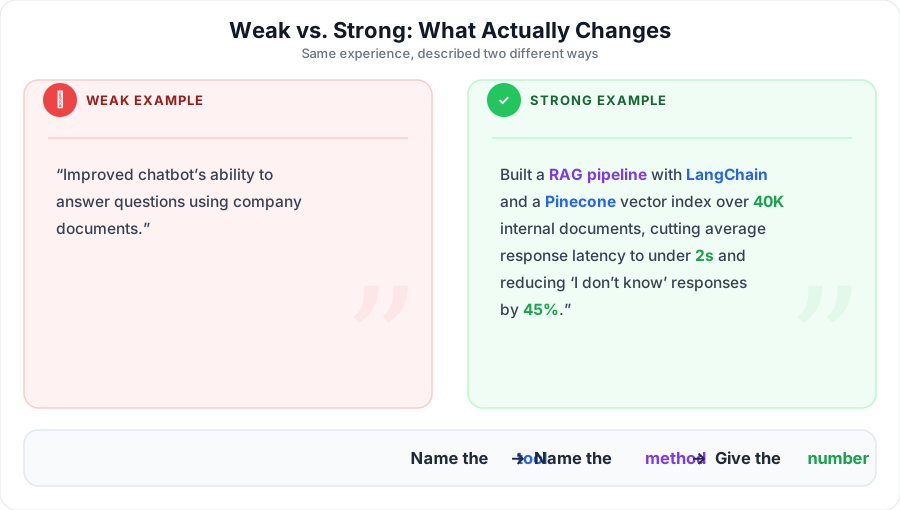
Vocabulary only helps if you know where to put it. Here's what the difference actually looks like on a resume line, across different types of work:
RAG feature (ML Engineer / Applied AI)
- ❌ Weak: "Improved chatbot's ability to answer questions using company documents."
- ✅ Strong: "Built a RAG pipeline with LangChain and a Pinecone vector index over 40K internal documents, cutting average response latency to under 2s and reducing 'I don't know' responses by 45%."
Model fine-tuning (ML Engineer / Data Scientist)
- ❌ Weak: "Trained and improved a machine learning model for classification."
- ✅ Strong: "Fine-tuned a DistilBERT classifier on 120K labeled support tickets using PyTorch, improving F1 score from 0.71 to 0.89 and cutting manual triage time by 6 hours/week."
Prompt engineering / LLM feature (any AI-adjacent role)
- ❌ Weak: "Worked with AI to add smart features to the product."
- ✅ Strong: "Designed and version-controlled prompt templates for a Claude-powered summarization feature, using structured outputs and function calling to hit 98% valid-JSON response rate in production."
Vector databases / embeddings (ML Engineer / Data Scientist)
- ❌ Weak: "Used vector search to improve results."
- ✅ Strong: "Migrated semantic search from a keyword index to Qdrant with OpenAI text-embedding-3 embeddings, improving top-5 retrieval relevance by 32% in offline eval."
Evaluation / MLOps (ML Engineer)
- ❌ Weak: "Made sure the AI system worked correctly before release."
- ✅ Strong: "Built an automated eval harness with RAGAS to score faithfulness and answer relevance on every PR, catching regressions before deploy and cutting production hallucination reports by 60%."
AI coding assistants (baseline, any engineering role)
- ❌ Weak: "Comfortable using modern developer tools."
- ✅ Strong: "Used Claude Code and MCP-connected tools daily to ship features end-to-end, including writing and running an internal MCP server for querying production logs."
Classic data science metric (Data Scientist)
- ❌ Weak: "Analyzed data to find insights and support the business."
- ✅ Strong: "Built a churn-prediction model (XGBoost, 0.84 AUC) that flagged at-risk accounts 3 weeks earlier, informing a retention campaign that reduced churn by 8% quarter-over-quarter."
The pattern in every "Strong" version: name the tool → name the method → give the number. Miss any one of the three and the line gets noticeably weaker — but missing the tool name is the one that actually costs you the AI screening match.
How to Actually Write It (Structure & Formatting)
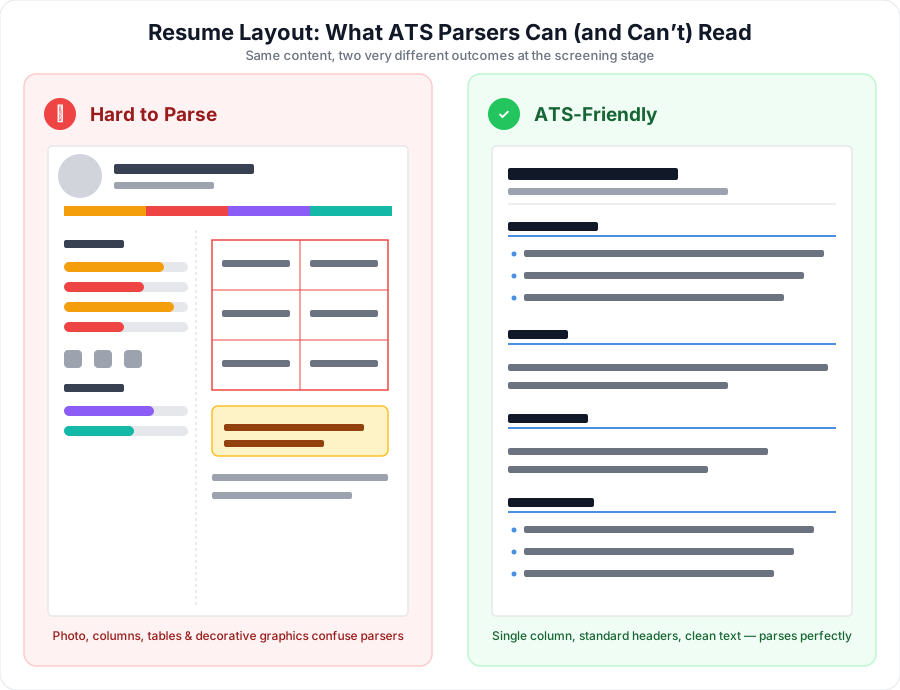
- Use standard section headers. "Experience," "Skills," "Education" — not creative alternatives. Non-standard headers are a common reason ATS/AI parsers fail to extract content correctly.
- Avoid tables, columns, and text boxes for anything you need parsed correctly. Multi-column layouts are still a leading cause of resumes getting mis-parsed or silently dropped fields.
- Put a dedicated "Technical Skills" or "Tools" line near the top, not just embedded in bullet prose. Screening tools weight explicit skill lists heavily, and human reviewers scan it first.
- Mirror the job description's exact terminology. If the posting says "LLM observability," don't write "AI monitoring" — match the phrase. Semantic matching helps, but exact-term matching still wins on relevance scoring.
- Quantify every bullet where you can. Latency reduced, accuracy improved, cost per query dropped, tickets deflected — numbers are what separates "worked on" from "delivered."
- Export as PDF from a text-based source (not a scanned image or a heavily designed template), and keep it to one page unless you have 8+ years of relevant experience.
Common Mistakes That Get AI/ML Resumes Filtered Out
- Describing impact without naming the mechanism. "Improved model performance" tells a screener nothing to match against.
- Listing "AI/Machine Learning" as a single skill. It's too broad to score against a specific job description — break it into the actual tools and techniques.
- Burying tool names in paragraph prose instead of a scannable skills section.
- Claiming breadth without specificity — e.g., "experience with LLMs" instead of "built production features using the Anthropic Claude API with tool use and structured outputs."
- Assuming a human will fill in the gaps. In 2026, assume the first read is automated, and write accordingly — explicit beats implied, every time.
Quick Pre-Submit Checklist
Content
- [ ] Specificity — every bullet names the tool or framework, not just the category
- [ ] Quantified impact — at least one number per bullet where possible
- [ ] Terminology match — language mirrors the target job description's exact phrasing
Structure & Format
- [ ] Skills section — standalone Skills/Tools block near the top
- [ ] Clean parsing — no tables, columns, or graphics
- [ ] Clean export — text-based PDF, not a scanned image or design template
Role Fit
- [ ] Baseline AI fluency — AI coding assistants, prompt engineering, LLM APIs, even for adjacent roles
- [ ] Role-specific depth — vector DBs, RAG frameworks, eval tooling for ML Engineer / Data Scientist / Applied AI roles
Preparing for the interview that comes after the resume gets through? Start with 20 Google AI/ML interview questions — five of them are playable right in the article — then practice the full sets on Squizzu to sharpen the specifics you'll need to defend in the room. The same specificity that gets a resume past the screen is what gets tested face-to-face.
References
- Crist, Carolyn. "1 in 3 companies say AI will run their hiring process by 2026." HR Dive, Aug. 22, 2025. (citing a Resume.org survey of nearly 1,400 full-time U.S. workers, published Aug. 19, 2025)